FOR RESEARCH USE ONLY · FREE UK SHIPPING OVER £100 · WORLDWIDE SHIPPING NOW LIVE · HPLC VERIFIED · BATCH DOCUMENTATION ON REQUEST · FOR RESEARCH USE ONLY · FREE UK SHIPPING OVER £100 · WORLDWIDE SHIPPING NOW LIVE · HPLC VERIFIED · BATCH DOCUMENTATION ON REQUEST · FOR RESEARCH USE ONLY · FREE UK SHIPPING OVER £100 · WORLDWIDE SHIPPING NOW LIVE · HPLC VERIFIED · BATCH DOCUMENTATION ON REQUEST · FOR RESEARCH USE ONLY · FREE UK SHIPPING OVER £100 · WORLDWIDE SHIPPING NOW LIVE · HPLC VERIFIED · BATCH DOCUMENTATION ON REQUEST ·
For in vitro research use only. NAD+ is not for human or veterinary consumption, diagnosis, treatment, or prevention of any condition.
NAD+ (Nicotinamide Adenine Dinucleotide) is a molecule found in every living cell. It plays a central role in how cells produce energy inside mitochondria (the cell's power stations). It is also essential for activating sirtuins - a family of proteins involved in repairing DNA, regulating genes, and helping cells respond to stress.
CAS Number
53-84-9
Molecular Formula
C₂₁H₂₇N₇O₁₄P₂
HPLC Purity
99.5% (batch-verified)
Form
Lyophilised powder
Storage
2–8°C, desiccated, protected from light
Classification
Research reagent - in vitro use only
≥99%
HPLC purity
3rd-Party Tested
Independent lab
CoA Every Order
Batch-specific
Tracked 24
Royal Mail UK
Pay by Bank
No card stored
NAD+ research overview
NAD+ (Nicotinamide Adenine Dinucleotide, oxidised form) is a dinucleotide coenzyme found in all living cells, where it plays a central role in cellular energy metabolism and redox biochemistry. Structurally, NAD+ consists of two nucleotides — one containing adenine and one containing nicotinamide — linked by a phosphate bridge. It cycles between its oxidised form (NAD+) and its reduced form (NADH) as it shuttles electrons in metabolic reactions, acting as an essential electron carrier in glycolysis, the citric acid cycle, and oxidative phosphorylation. Unlike the synthetic peptides in the Velox Peptides catalogue, NAD+ is an endogenous molecule present in every cell of the body.
Beyond its role in bioenergetics, NAD+ is a substrate for several enzymatic reactions that are active subjects of current research. Sirtuins (SIRT1–7), a family of NAD+-dependent protein deacylases, use NAD+ as a cofactor to remove acetyl and acyl groups from target proteins — a regulatory mechanism involved in gene expression, DNA repair, and metabolic enzyme activity. PARP enzymes (poly ADP-ribose polymerases) consume NAD+ to synthesise poly-ADP-ribose chains in response to DNA strand breaks, making NAD+ a central factor in the DNA damage response. CD38 and CD157 use NAD+ to generate cyclic ADP-ribose, a second messenger involved in calcium signalling and immune cell function.
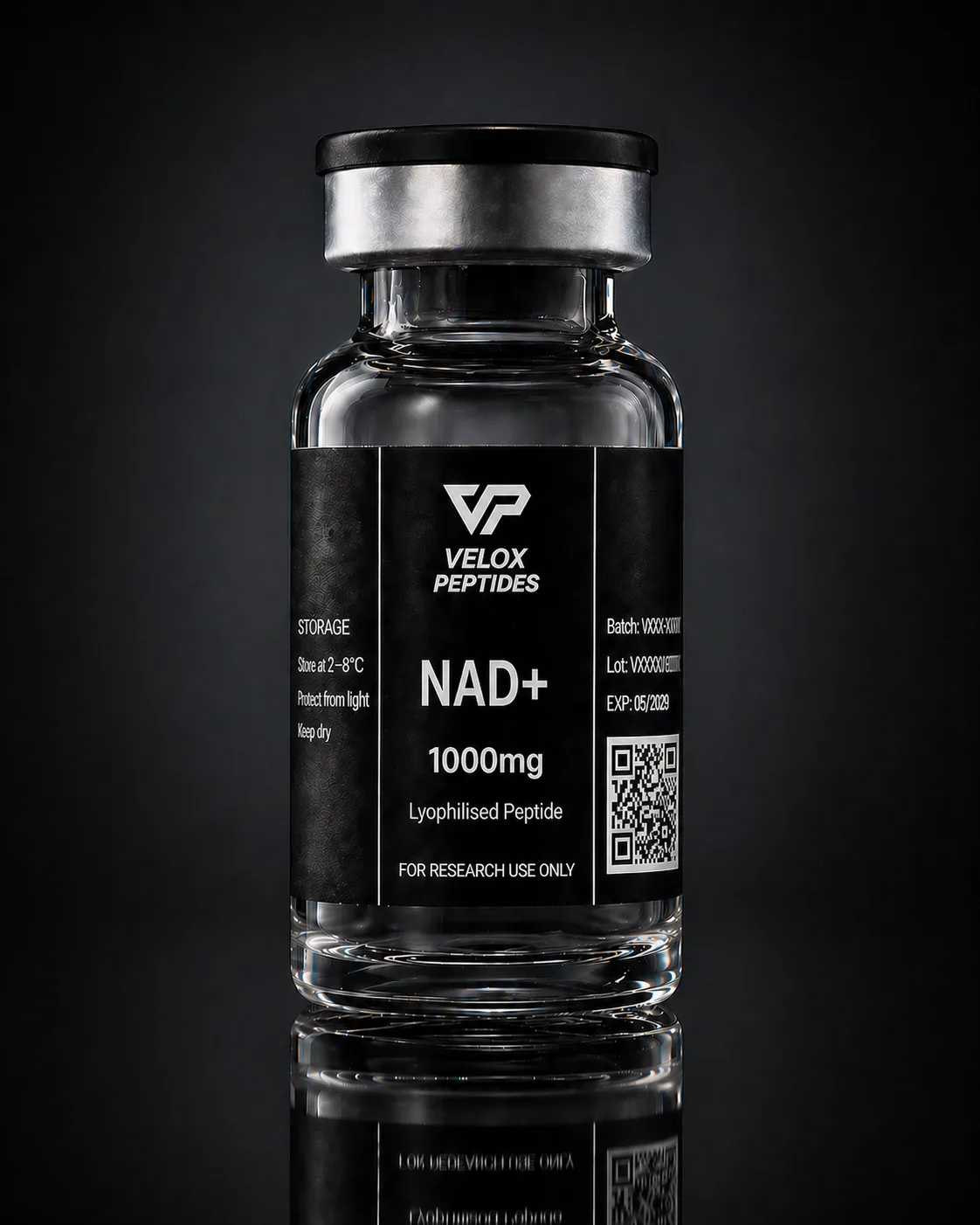
NAD+ levels are reported to decline with age in mammalian tissues, and this decline has prompted research interest in NAD+ biology in the context of aging, mitochondrial dysfunction, neurodegeneration, and metabolic disease. Preclinical cell studies have examined the effects of NAD+ on sirtuin activity, mitochondrial biogenesis markers (including PGC-1α), and the cellular response to oxidative and genotoxic stress. Velox Peptides supplies NAD+ at 99.5% HPLC-verified purity in 1000mg vials as a lyophilised research reagent. Not for human or veterinary consumption.
Summary paraphrased from the peer-reviewed preclinical literature. For in vitro research use only. For source citations, email support@veloxpeps.com.
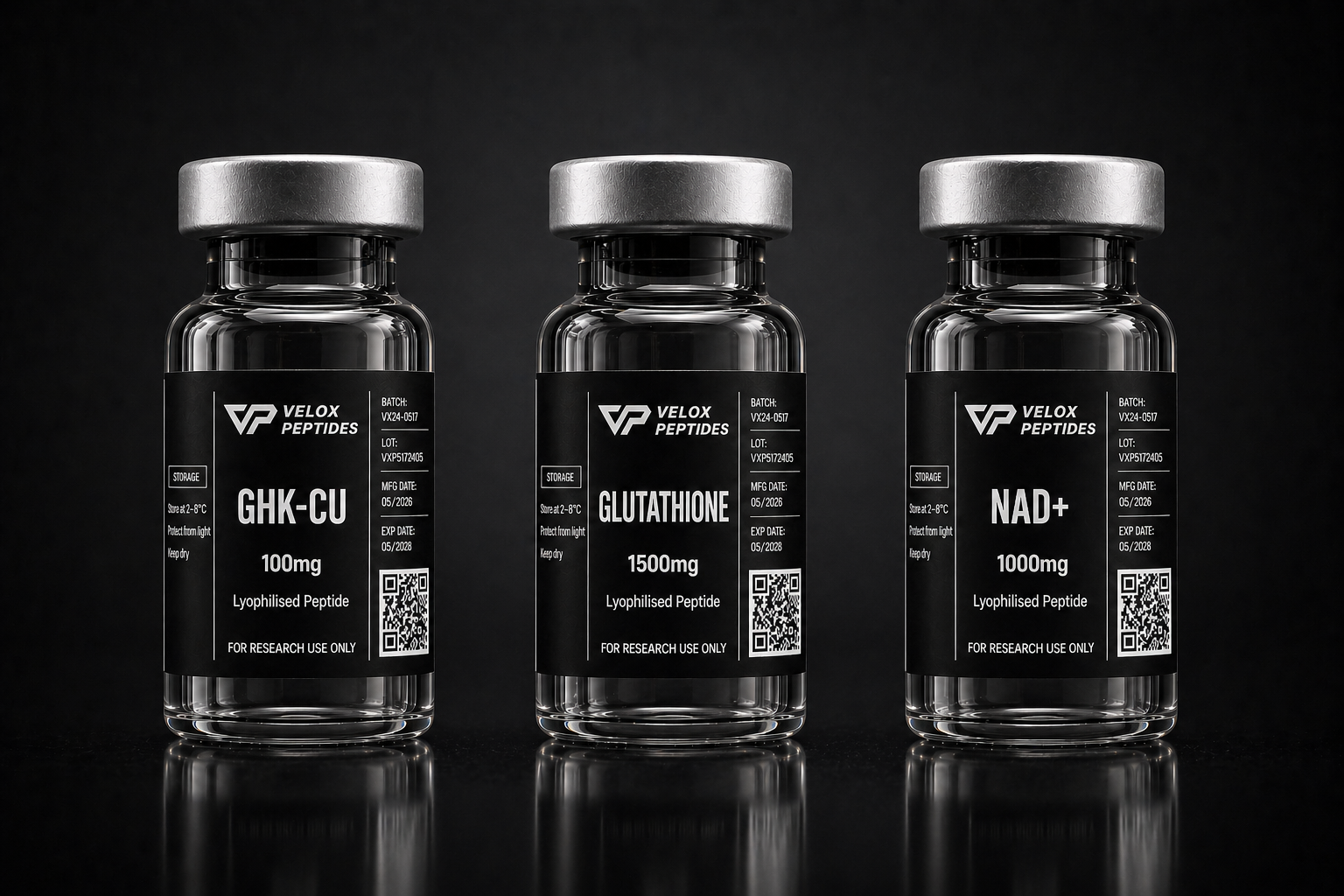
NAD+ is supplied at 99.5% HPLC-verified purity. Batch documentation is available on request.
How is NAD+ supplied and reconstituted for research use?
NAD+ is supplied as a lyophilised powder in sterile single-use vials. For in vitro research use, reconstitution is performed with bacteriostatic water. See the reconstitution calculator for volume calculations based on required concentration.
What is NAD+ used for in preclinical research?
NAD+ is studied in the peer-reviewed literature across the pathways described in the research overview above. Velox Peptides supplies NAD+ strictly as a research reagent for in vitro use by qualified researchers. It is not a medicinal product and is not for human or veterinary consumption.
What is the CAS number for NAD+?
The CAS registry number for NAD+ is 53-84-9.
Is NAD+ legal to buy in the UK?
Yes. NAD+ is lawful to purchase in the United Kingdom strictly for legitimate in vitro scientific research purposes. It is not a controlled substance under UK law and is not subject to prescription requirements when purchased for research use. Velox Peptides supplies NAD+ solely as a research reagent to qualified researchers. Buyers are responsible for ensuring all use complies with applicable law and with Velox Peptides’ Research Use Policy.
What is the relationship between NAD+ and sirtuins in research?
Sirtuins (SIRT1–7) are a family of NAD+-dependent protein deacylases that require NAD+ as a co-substrate (not merely a cofactor) to function — each catalytic cycle consumes one molecule of NAD+. This coupling means that cellular NAD+ availability directly regulates sirtuin activity. Research in aging biology, metabolic disease, and epigenetics uses exogenous NAD+ to examine how NAD+ repletion affects sirtuin-mediated protein deacetylation, gene expression changes, mitochondrial biogenesis (via SIRT1/PGC-1α), and DNA repair (via SIRT6). Velox Peptides supplies NAD+ as a 99.5%-purity lyophilised reagent for in vitro use.
How quickly is my order dispatched and delivered?
Orders placed before 2pm on a working day are dispatched the same day via Royal Mail Tracked 24, typically arriving in 1–2 working days, with tracking emailed on dispatch. UK shipping is free over £100, and EU shipping is available.
How do I pay, and is it secure?
We accept Pay by Bank - an instant, secure open-banking payment via Fena, where you authorise the payment in your own banking app and no card details are stored on our site. Manual UK bank transfer is available as a fallback. Orders are dispatched within 24 hours of cleared payment.
Does my order include a certificate of analysis?
Yes. Every order includes a batch-specific Certificate of Analysis documenting third-party HPLC purity and mass-spectrometry identity confirmation, emailed with your order confirmation. Previous batch CoAs are archived in our CoA library.
Compliance notice
For in vitro research use only. NAD+ is supplied solely as a research reagent for qualified professionals conducting in vitro or animal-model studies. It is not a medicinal product within the meaning of the Human Medicines Regulations 2012. It has not been evaluated by the MHRA or FDA. It is not intended for human or veterinary consumption, diagnosis, treatment, cure, or prevention of any condition. Any use outside lawful scientific research is outside the scope of sale.
Compliance statement.
Velox Peptides supplies research reagents for in vitro use by qualified researchers. Every compound is sold strictly as a research reagent. No product is a medicinal product within the meaning of the Human Medicines Regulations 2012. No product has been evaluated by the MHRA or FDA. No product is intended for human or veterinary consumption, diagnosis, treatment, cure, or prevention of any condition. Any use outside lawful scientific research is outside the scope of sale. See our Research Use Policy and MHRA Statement.
AGE VERIFICATION
Confirm your eligibility
This website is restricted to qualified researchers aged 21 or over. All products are for in vitro research use only.
All products sold for research use only. Not for human consumption. Not evaluated by the MHRA or FDA.
 STACK IMAGE