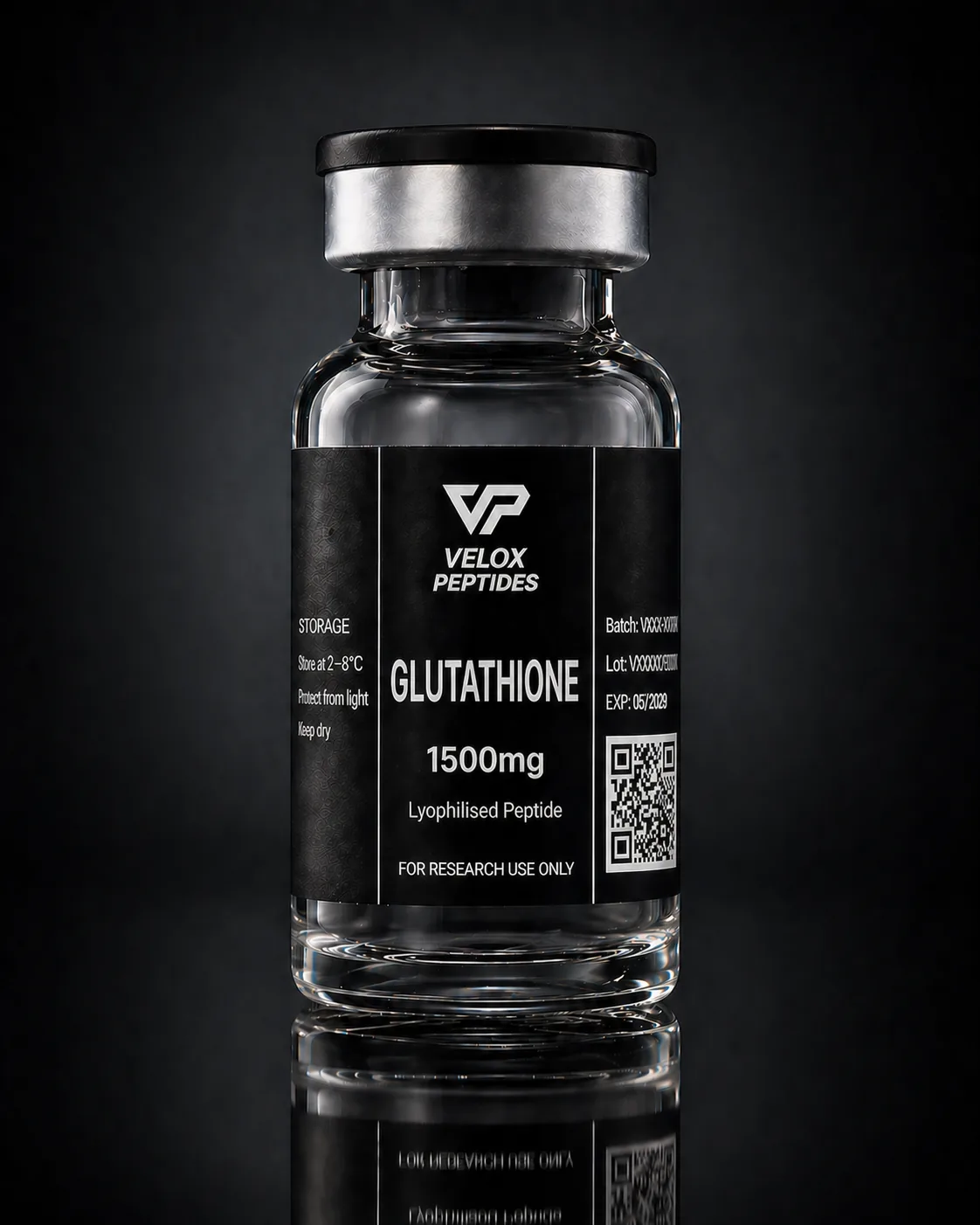
Glutathione L-Glutathione (Reduced)
Glutathione is a small molecule made of three amino acids, found naturally in almost every cell in the body. It acts as one of the cell's main defences against oxidative damage - a process where unstable molecules called free radicals can harm DNA and cell structures. Studies have investigated its role in how cells produce energy and maintain their internal chemical balance.
- CAS Number
- 70-18-8
- Molecular Formula
- C₁₀H₁₇N₃O₆S
- HPLC Purity
- 99.2% (batch-verified)
- Form
- Lyophilised powder
- Storage
- 2–8°C, desiccated, protected from light
- Classification
- Research reagent - in vitro use only
Glutathione research overview
Glutathione (L-Glutathione, reduced form; GSH) is a tripeptide consisting of glutamic acid, cysteine, and glycine (Glu-Cys-Gly), and is the most abundant low-molecular-weight thiol compound in mammalian cells. It is synthesised within cells in two sequential ATP-dependent steps, and maintained in its biologically active reduced form (GSH) through the activity of glutathione reductase using NADPH. Unlike most other research compounds in the Velox Peptides catalogue, glutathione is not a peptide hormone or receptor ligand; it is a metabolic molecule central to fundamental cellular biochemistry, with intracellular concentrations in the millimolar range in healthy cells.
Research on glutathione spans several areas of cell biology. In antioxidant research, GSH acts as a direct free radical scavenger and is an essential cofactor for glutathione peroxidases (GPx enzymes), which detoxify hydrogen peroxide and lipid hydroperoxides. In detoxification research, glutathione serves as the substrate for glutathione S-transferases (GSTs) — a large superfamily of enzymes that conjugate GSH to electrophilic xenobiotics and reactive metabolites, initiating their excretion via the mercapturic acid pathway. In redox signalling research, GSH participates in protein glutathionylation, a reversible post-translational modification that protects protein thiol groups under oxidative conditions.
Glutathione depletion is an active research model in cell biology, with studies using GSH-depleting agents (such as buthionine sulfoximine or diethyl maleate) to examine the cellular consequences of oxidative stress. Exogenous GSH supplementation studies in cell models have examined its ability to restore redox homeostasis, modulate cell viability under oxidative challenge, and influence immune cell function — including T-cell proliferation and cytokine secretion. Velox Peptides supplies L-Glutathione (reduced) at 99.2% HPLC-verified purity in 1500mg vials as a lyophilised research reagent. Not for human or veterinary consumption.
Summary paraphrased from the peer-reviewed preclinical literature. For in vitro research use only. For source citations, email support@veloxpeps.com.
Compound specifications
| Common name | Glutathione |
|---|---|
| Full name | L-Glutathione (Reduced) |
| CAS number | 70-18-8 |
| Molecular formula | C₁₀H₁₇N₃O₆S |
| Molecular weight | 307.3 g/mol |
| Sequence | γ-L-glutamyl-L-cysteinyl-glycine |
| HPLC purity | 99.2% (batch-verified) |
| Appearance | White to off-white lyophilised powder |
| Solubility | Bacteriostatic water, sterile saline |
| Storage (lyophilised) | 2–8°C, protected from light |
| Storage (reconstituted) | 2–8°C, up to 28 days |
| Supplied as | 1500mg |
Batch testing and certificate of analysis
Every batch of Glutathione is third-party HPLC-tested prior to dispatch. Batch documentation is available on request.
Previous batch CoAs are archived in the CoA library. For batch-specific CoA requests prior to purchase, contact support@veloxpeps.com.
Frequently Asked Research-Use Questions
What purity is Velox Peptides Glutathione?
How is Glutathione supplied and reconstituted for research use?
What is Glutathione used for in preclinical research?
What is the CAS number for Glutathione?
Is Glutathione legal to buy in the UK?
What is the difference between reduced glutathione (GSH) and oxidised glutathione (GSSG)?
How quickly is my order dispatched and delivered?
How do I pay, and is it secure?
Does my order include a certificate of analysis?
Compliance notice
For in vitro research use only. Glutathione is supplied solely as a research reagent for qualified professionals conducting in vitro or animal-model studies. It is not a medicinal product within the meaning of the Human Medicines Regulations 2012. It has not been evaluated by the MHRA or FDA. It is not intended for human or veterinary consumption, diagnosis, treatment, cure, or prevention of any condition. Any use outside lawful scientific research is outside the scope of sale.