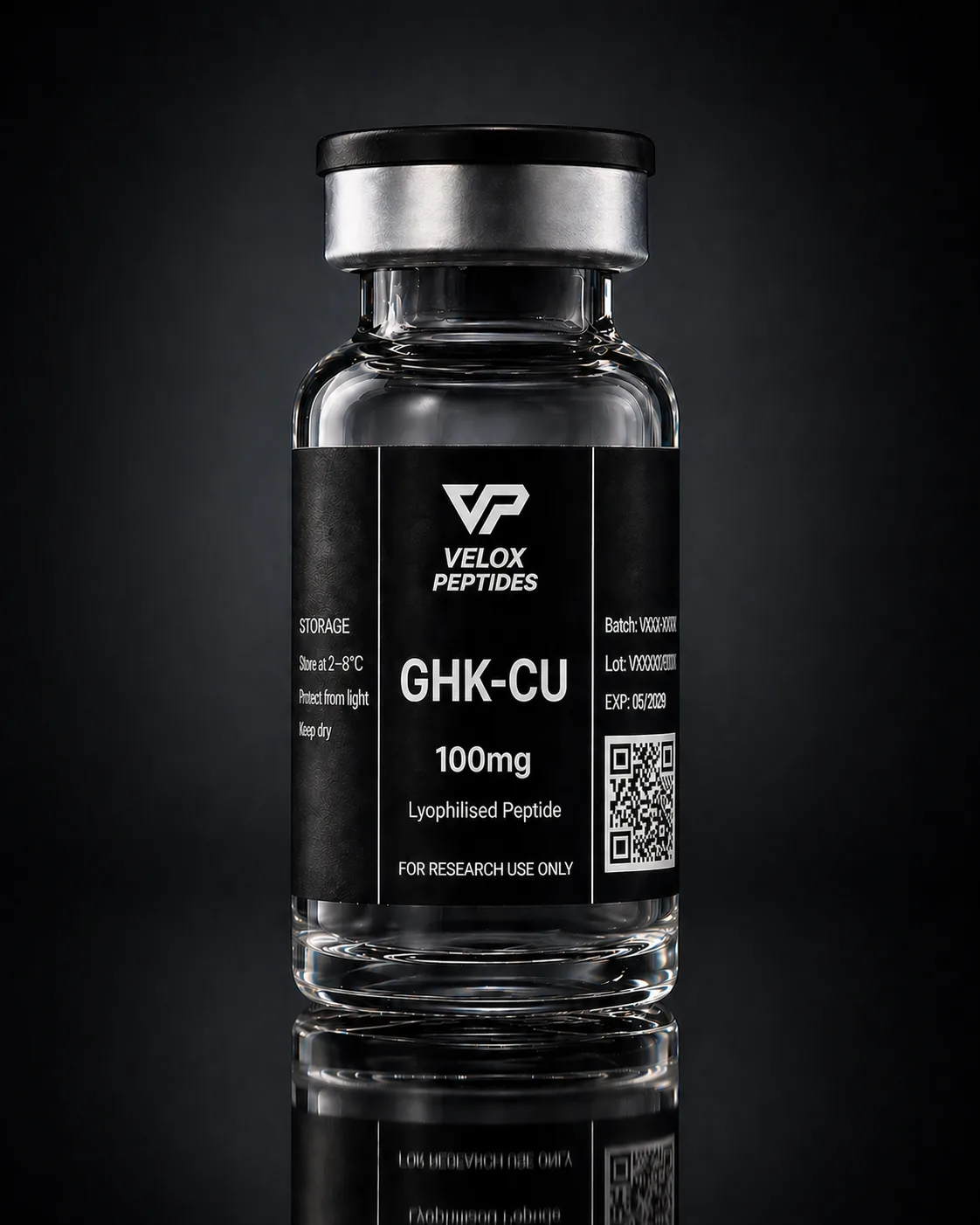
GHK-Cu Copper Tripeptide-1
GHK-Cu is a tiny naturally occurring molecule made of just three amino acids, found in mammalian blood, where it is bound to a copper atom. In skin cell and animal studies, research has investigated how it affects the genes that produce collagen and elastin - the proteins that give skin and tissue their strength and flexibility.
- CAS Number
- 49557-75-7
- Molecular Formula
- C₁₄H₂₃CuN₆O₄
- HPLC Purity
- 99% (batch-verified)
- Form
- Lyophilised powder
- Storage
- 2–8°C, desiccated, protected from light
- Classification
- Research reagent - in vitro use only
GHK-Cu research overview
GHK-Cu (Glycyl-L-histidyl-L-lysine copper(II)) is a naturally occurring human tripeptide complexed with copper(II) ions. The GHK tripeptide was first isolated from human plasma albumin in the 1970s and subsequently identified in saliva, urine, and wound fluid. Unlike the majority of research reagents in the Velox Peptides catalogue, GHK-Cu is an endogenous compound — it occurs naturally in the human body and its concentrations are known to decline with age — though it is supplied here as a synthesised research reagent at defined purity for controlled experimental conditions.
Research on GHK-Cu has centred on tissue remodelling and gene expression modulation. Cell culture studies have examined its effects on fibroblast activity, specifically collagen and glycosaminoglycan synthesis, and on matrix metalloproteinase (MMP) expression. MMPs are enzymes responsible for breaking down extracellular matrix components; GHK-Cu has been found in several studies to modulate both MMP upregulation and the expression of their endogenous inhibitors (TIMPs), suggesting a regulatory role in matrix turnover. This has made it an active subject in tissue repair biology, skin biology, and dermatological research.
Beyond collagen and tissue repair research, GHK-Cu has been examined for its antioxidant properties — specifically its ability to chelate copper ions and reduce copper-catalysed oxidative damage — and for broader gene expression effects. Studies using DNA microarray and gene expression profiling approaches have identified large numbers of genes potentially modulated by GHK-Cu exposure in cell models, including genes associated with inflammation regulation, neurological function, and cell signalling. Velox Peptides supplies GHK-Cu at 99% HPLC-verified purity as a lyophilised copper tripeptide research reagent. Not for human or veterinary consumption.
Summary paraphrased from the peer-reviewed preclinical literature. For in vitro research use only. For source citations, email support@veloxpeps.com.
Compound specifications
| Common name | GHK-Cu |
|---|---|
| Full name | Copper Tripeptide-1 |
| CAS number | 49557-75-7 |
| Molecular formula | C₁₄H₂₃CuN₆O₄ |
| Molecular weight | 402.9 g/mol |
| Sequence | Gly-His-Lys · Cu²⁺ |
| HPLC purity | 99% (batch-verified) |
| Appearance | White to off-white lyophilised powder |
| Solubility | Bacteriostatic water, sterile saline |
| Storage (lyophilised) | 2–8°C, protected from light |
| Storage (reconstituted) | 2–8°C, up to 28 days |
| Supplied as | 100mg |
Batch testing and certificate of analysis
Every batch of GHK-Cu is third-party HPLC-tested prior to dispatch. Batch documentation is available on request.
Previous batch CoAs are archived in the CoA library. For batch-specific CoA requests prior to purchase, contact support@veloxpeps.com.
Frequently Asked Research-Use Questions
What purity is Velox Peptides GHK-Cu?
How is GHK-Cu supplied and reconstituted for research use?
What is GHK-Cu used for in preclinical research?
What is the CAS number for GHK-Cu?
Is GHK-Cu legal to buy in the UK?
What is the copper content and structure of GHK-Cu?
How quickly is my order dispatched and delivered?
How do I pay, and is it secure?
Does my order include a certificate of analysis?
Compliance notice
For in vitro research use only. GHK-Cu is supplied solely as a research reagent for qualified professionals conducting in vitro or animal-model studies. It is not a medicinal product within the meaning of the Human Medicines Regulations 2012. It has not been evaluated by the MHRA or FDA. It is not intended for human or veterinary consumption, diagnosis, treatment, cure, or prevention of any condition. Any use outside lawful scientific research is outside the scope of sale.