FOR RESEARCH USE ONLY · FREE UK SHIPPING OVER £100 · WORLDWIDE SHIPPING NOW LIVE · HPLC VERIFIED · BATCH DOCUMENTATION ON REQUEST · FOR RESEARCH USE ONLY · FREE UK SHIPPING OVER £100 · WORLDWIDE SHIPPING NOW LIVE · HPLC VERIFIED · BATCH DOCUMENTATION ON REQUEST · FOR RESEARCH USE ONLY · FREE UK SHIPPING OVER £100 · WORLDWIDE SHIPPING NOW LIVE · HPLC VERIFIED · BATCH DOCUMENTATION ON REQUEST · FOR RESEARCH USE ONLY · FREE UK SHIPPING OVER £100 · WORLDWIDE SHIPPING NOW LIVE · HPLC VERIFIED · BATCH DOCUMENTATION ON REQUEST ·
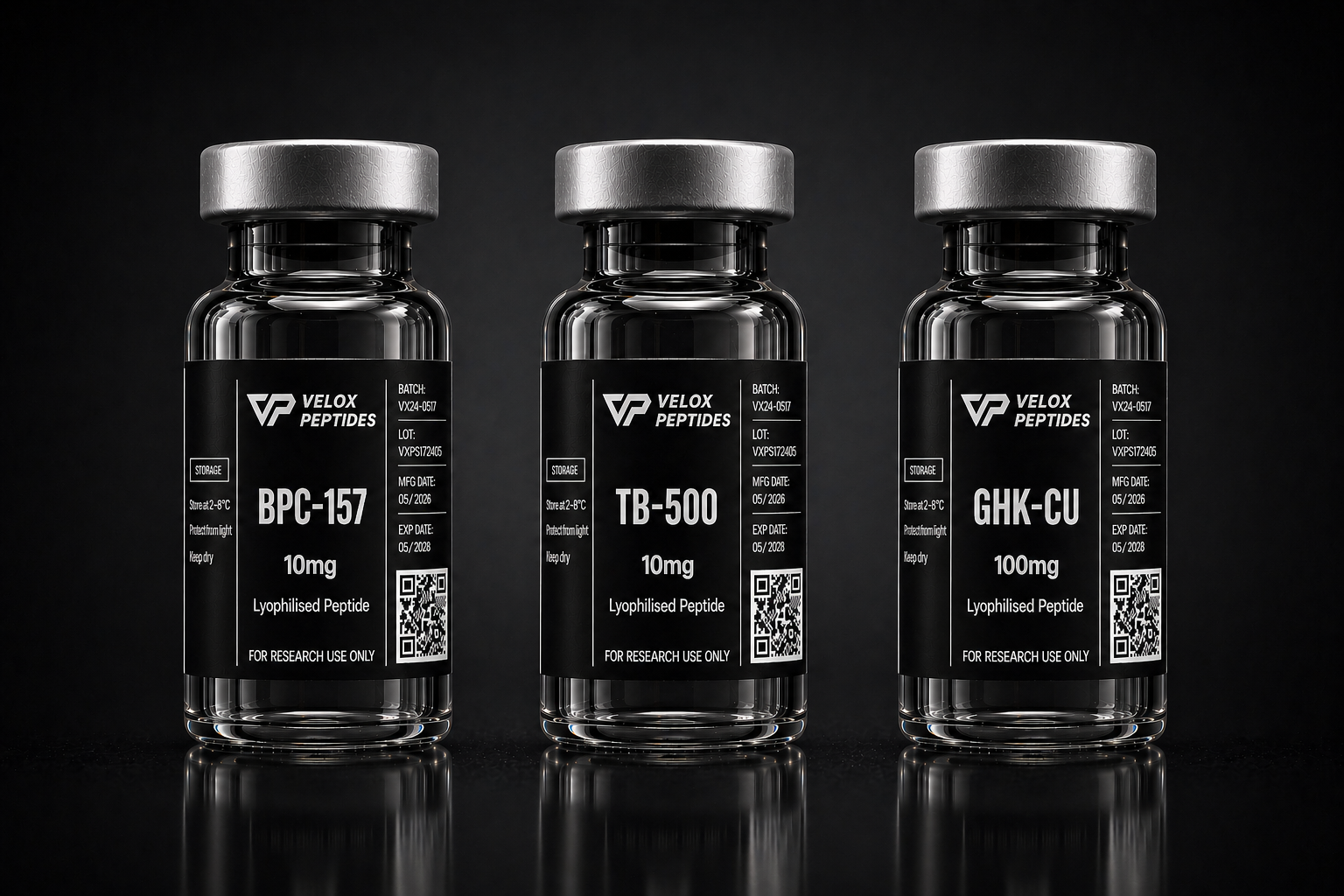
Angiogenic Repair Research Bundle BPC-157 + TB-500 + GHK-Cu
For in vitro research use only. Ultimate Repair Stack is not for human or veterinary consumption, diagnosis, treatment, or prevention of any condition.
Research bundle combining three of the most studied tissue-focused peptides in preclinical repair research. BPC-157 is investigated for blood vessel formation, wound closure, and mucosal protection; TB-500 for actin regulation and cellular migration in tissue organisation; GHK-Cu for collagen synthesis and tissue remodelling.
Research overview
Research bundle combining three of the most studied tissue-focused peptides in preclinical repair research. BPC-157 is investigated for blood vessel formation, wound closure, and mucosal protection; TB-500 for actin regulation and cellular migration in tissue organisation; GHK-Cu for collagen synthesis and tissue remodelling. Together they cover vascular, cellular, and structural aspects of tissue repair pathway research. Three individual lyophilised vials. For in vitro research use only.
A 15-amino-acid synthetic peptide that is among the most extensively studied repair-focused compounds in preclinical science. Rodent studies have investigated its role in stimulating new blood vessel formation (angiogenesis), accelerating wound tissue closure, and protecting the stomach and intestinal lining from experimentally induced damage.
A synthetic version of Thymosin Beta-4, a protein naturally present in mammalian tissue. Preclinical studies investigate its role in regulating actin - a structural protein that controls how cells move and organise during tissue repair.
A naturally occurring tripeptide found in mammalian blood that carries a copper atom. In skin cell and animal research models, it has been studied for its ability to upregulate the genes responsible for producing collagen and elastin - the structural proteins that give tissue its strength and elasticity.
For in vitro research use only. This stack is supplied solely as research reagents for qualified professionals conducting in vitro or animal-model studies. No compound in this stack is a medicinal product. None has been evaluated by the MHRA or FDA. None is intended for human or veterinary consumption, diagnosis, treatment, cure, or prevention of any condition.
Compliance statement.
Velox Peptides supplies research reagents for in vitro use by qualified researchers. Every compound is sold strictly as a research reagent. No product is a medicinal product within the meaning of the Human Medicines Regulations 2012. No product has been evaluated by the MHRA or FDA. No product is intended for human or veterinary consumption, diagnosis, treatment, cure, or prevention of any condition. Any use outside lawful scientific research is outside the scope of sale. See our Research Use Policy and MHRA Statement.
AGE VERIFICATION
Confirm your eligibility
This website is restricted to qualified researchers aged 21 or over. All products are for in vitro research use only.
All products sold for research use only. Not for human consumption. Not evaluated by the MHRA or FDA.